- BACKED | by Improbable
- Posts
- BACKED | January 2026: Decisions, trade-offs, signals
BACKED | January 2026: Decisions, trade-offs, signals
How early-stage builders are navigating a more demanding tech climate.

Welcome to the first edition of BACKED in 2026.
In December’s year-end review, we looked back across 2025 and noticed something important. The shift in building didn’t happen in headlines. It happened quietly as founders adjusted to tighter access to capital, practical uses of AI, and a compressed timeline for proving demand, revenue, and execution.
At the start of this year, we wanted to take a different approach. Rather than asking founders to predict the future, we asked them to focus on what’s on their desks right now: the trade-offs they’re weighing, the signals they’re tracking, and the decisions shaping their first quarter as early-stage startups. The environment they’re navigating today looks very different from what they were accustomed with.
AI has moved from exploration to expectation. Investors are less interested in possibility and more focused on proof, utility and measurable impact.
The funding landscape has fragmented. Capital is still available, but increasingly concentrated. For many, this has accelerated a shift towards revenue-driven models, independence, and venture-building approaches that don’t rely solely on traditional VC cycles.
Deep tech has returned to the spotlight, as the infrastructure enabling the next wave of innovation.
To capture what matters most, we asked founders across AI and Web3 some simple questions:
What lever has the most upside this year?
Which shifts are under-appreciated?
What capabilities are now table stakes?
What signals are worth watching closely?
Here’s what we found. Thanks for reading!
On founders’ desks this month |
Quick-fire answers from across the Improbable ecosystem.

If you had to describe your 2026 ambition in one word, what would it be?
Automation. This year, our focus is to automate our knowledge and analysis work, leveraging a variety of AI tools to fit our clients’ needs for accuracy and speed. The human-led analysis of Private Equity deals including portfolio company risks (now incorporating AI) and value creation opportunities (even more focused on AI) still relies on bringing proven expertise gained with top-tier investment firms. However, the approach is quickly flipping to a validation of insights generated through advanced prompting of generic models, alongside bespoke solutions for specific client needs.
Antoine Theysset, Co-Founder and CEO, Roju
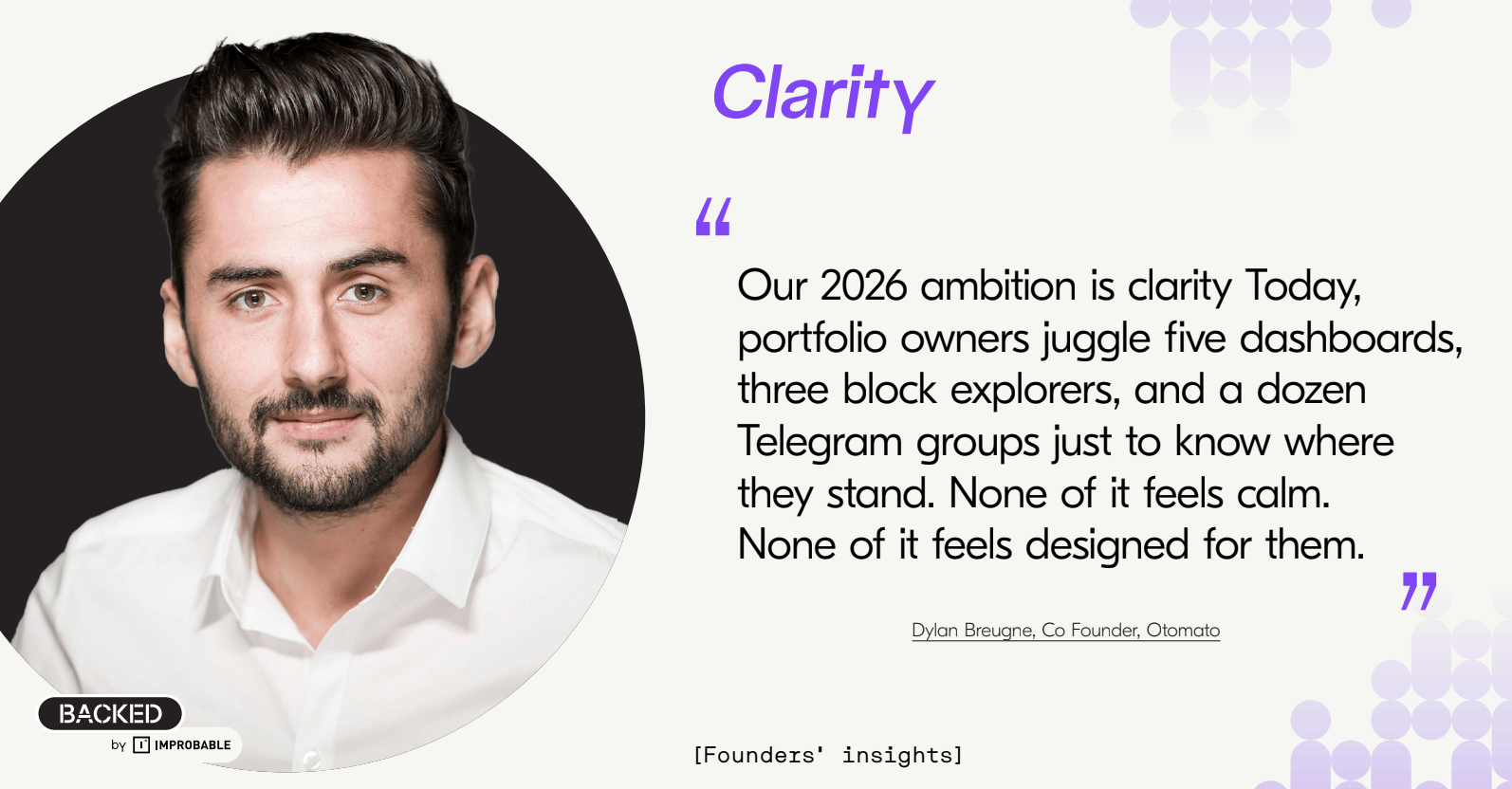
Clarity. Today, portfolio owners juggle five dashboards, three block explorers, and a dozen Telegram groups just to know where they stand. None of it feels calm. None of it feels designed for them. And portfolios today are passive: they show balances but never tell you what's happening. We're building the first reactive portfolio, one that automatically detects your positions across DeFi, perps, prediction markets, and beyond, and tells you only when something materially matters. Zero setup. Just paste an address. Nobody does this today. We want to make it the default.
Dylan Breugne, Co Founder, Otomato
Velocity. It captures what we are really focused on this year: engineering velocity, commercial velocity, and organisational pace. We have already proven the value proposition with Morrisons, Clingen, Baringa, and others. Now the ambition is simple: keep raising the speed of execution without compromising on quality, so we can turn proven outcomes into repeatable delivery at scale.
Jonathan Barrett, CEO, Kallikor
Scale. Expanding our ecosystem, reaching mainstream users, and unlocking use cases that simply weren’t possible before on existing blockchains.
Paul Thomas, CEO, Somnia

What lever has the most upside for you this year, and how are you leaning into it?
Distribution. Our core product works. The loop (detect positions, send relevant alerts, zero setup) is live. The bottleneck is getting in front of enough users, not building more features. We are leaning into ecosystem-by-ecosystem expansion, starting where we have the deepest coverage.
Dylan Breugne, Otomato
Hiring, but with a very specific angle. At our stage, hiring works best when focused on finding people who move the business forward, rather than simply filling roles. Every role needs to be a force multiplier: people who raise the output of the whole system, not just their own lane. That means building the delivery capability to onboard new customers, the sales capacity to convert pipeline, and the engineering leadership to maintain momentum as we scale.
Jonathan Barrett, Kallikor
Product has the most upside in the coming year. Somnia’s ecosystem is expanding in a big way this year, with flagship products that have the potential to reach a mainstream audience.
Paul Thomas, Somnia
Capital deployment, to co-invest in the AI transformation of PE-backed companies. We’re strategically aligning investments with where AI can materially improve how portfolio companies operate.
Antoine Theysset, Roju
What shift in AI or Web3 do you think will create the biggest opportunity this year?
AI is moving from insight generation to decision automation. Most enterprise AI is still stuck in analytics and dashboards. It surfaces insights but leaves humans to figure out what to do. Kallikor’s simulation platform sits in the gap between “AI suggests” and “action happens”. We’re building what we call the Supply Chain Genome – domain-specific intelligence that lets us move beyond generic recommendations, to decisions you can actually act on.
Jonathan Barrett, Kallikor
The verticalisation of applied AI to better serve specific industries and use cases. This includes AI due diligence for PE sponsors, value creation planning, and first-100-days plans. AI labs have invested significant resources in improving model output for various industry verticals, including finance and investing.
Antoine Theysset, Roju
The rise of prediction markets will be a massive opportunity. These platforms are already popular but still in their early stages. With Somnia’s performance capabilities, we can take prediction markets to the next level, and that is a big part of our vision for 2026.
Paul Thomas, Somnia
AI is becoming exponentially more powerful, and the compounding effect on small teams is massive. Tools like Claude Code are transforming what a single person can do. One engineer with the right AI tooling now operates like a full team of agents. Now combine that with permissionless finance. Everything is open, composable, and programmable. AI gives us the processing power to make sense of it all, and permissionless infrastructure gives us the access.
Dylan Breugne, Otomato

What structural shift in your market is under-appreciated?
The scalability offered by high-performance blockchains will make entirely new categories of applications possible. This is not just about lower costs and higher speeds, but about enabling use cases that were not feasible on conventional blockchains.
Paul Thomas, Somnia
The shift from more data to less noise. Most crypto tools still compete on coverage. But users with meaningful capital on-chain want fewer, better signals. They want to check nothing and be told only when something matters.
Dylan Breugne, Otomato
Large AI labs are rapidly eroding the differentiation that startups, even well-capitalised ones, have worked to create. While the ultimate moats remain proprietary data, distribution, and domain-specific talent, the first two are often already advantages for the big labs. That means preserving differentiation increasingly depends on attracting and retaining top talent with superior domain expertise.
Antoine Theysset, Roju
It’s the collapse of the planning-versus-execution divide in supply chains. For decades, planning and execution have been separate disciplines with separate systems and separate vendors. AI has made this separation actively harmful – you can’t optimise planning decisions without understanding real-time execution constraints. Many of the major incumbents are architected around this separation. Our simulation digital twin inherently bridges both because it models the whole system.
Jonathan Barrett, Kallikor
Which AI or Web3 capability is becoming table stakes this year?
Everyone now expects to ask questions in plain English and get useful answers back. For us, that means investing in conversational interfaces to our simulation platform. A supply chain director asking, “What happens to service levels if we cut safety stock by 10%?" will be getting a real answer without writing a query. But the risk with LLM interfaces is sounding confident about shallow analysis. We need to ensure the conversation exposes genuine simulation depth, rather than papering over something simpler.
Jonathan Barrett, Kallikor
High throughput and low fees are quickly becoming baseline expectations rather than differentiators. Performance now needs to be demonstrated through the applications it enables.
Paul Thomas, Somnia
As more asset types move on-chain, a capability that is becoming essential this year is portfolio-aware monitoring, where users expect a single, coherent view across DeFi, prediction markets, and eventually tokenised real-world assets.
Dylan Breugne, Otomato
Domain expertise, what Palantir refers to as ontologies and workflows, particularly a clear understanding of what clients need and what they can and cannot do in-house. Over time, consolidation will shift the logic toward who can aggregate expertise across verticals.
Antoine Theysset, Roju

Finally, what external signal are you watching most closely this year?
User retention after the first week of alerts. If users keep notifications enabled, relevance is right. If they mute or uninstall, we tighten defaults before scaling further.
Dylan Breugne, Otomato
Retailer capital expenditure decisions in the first half of the year. UK retailers face a difficult 2026: cost pressures from the budget changes, cautious consumers, ongoing margin squeeze. How they allocate capital in H1 tells us whether they're investing through difficulty or retreating to cost-cutting. We're watching procurement behaviour closely: are RFP timelines extending, are decision committees growing, and are CFOs getting more involved?
Jonathan Barrett, Kallikor
Capital deployed and capital returned. The health of IPO markets, M&A activity, and private market fundraising will determine whether investors are in deployment, exit/liquidity or ongoing portfolio value maximisation mode.
Antoine Theysset, Roju
Customer behaviour. People are burned out on vaporware. A shift toward real utility and tangible value will define the next phase of adoption.
Paul Thomas, Somnia
Building something ambitious?
We work with founders solving complex problems in AI transformation, the metaverse, and Web3 – the kind that don’t get built alone.
Inside Improbable - A quick glance at the venture building portfolio |

Otomato goes multichain
Otomato is building a DeFi assistant that monitors your on-chain positions and alerts customers when something needs attention.
After onboarding 2,000+ users and integrating 25+ protocols on HyperEVM, the team has now expanded to multichain support. The insight was simple: the real problem in DeFi isn’t alerts, it’s fragmentation across chains.
Otomato now detects positions across Ethereum, Arbitrum, Base, Hyperliquid and more automatically.
We spoke with the founders last year about the thinking behind the product and what early user behaviour was teaching them.
Somnia’s first Dreamathon founders
Somnia’s Dreamathon has welcomed its first cohort of founders.
The projects emerging from it offer a glimpse into what builders start exploring when the performance limits of a blockchain are no longer the constraint. Not faster versions of familiar apps, but ideas that were previously impractical to build at all.
An early look at the kinds of experiments this environment is beginning to produce.
Read more here.
Industry pulse |

Herman joined the basketball.fun live podcast for a wide-ranging discussion on immersive infrastructure and venture building.
The session drew 15,000+ live viewers, a strong signal of appetite for deeper conversations around where the internet is heading.
That’s all folks.
Across AI and Web3, founders are making bold bets, experimenting with new models, and shaping what comes next. In 2026, the pace of innovation will only accelerate, and we’ll make sure to be tracking it closely.
Stay tuned for more founder insights and snapshots in the upcoming editions of BACKED.
Have feedback, suggestions, or topics you'd like us to dive into? Email us at: [email protected].
Building something ambitious?
Come build with us! We work with founders who solve the hard problems and shape the future. Get in touch.