- BACKED | by Improbable
- Posts
- BACKED | 2025 in review
BACKED | 2025 in review
The year that reshaped how we build
As 2025 closes, we wish our readers a joyful holiday season and a prosperous start to the new year.
The vantage point of our R&D and venture-building teams allows us to see the year for what it truly was: not a collection of headline moments, but a series of deeper structural shifts that quietly reshaped the terrain we build on.
AI moved faster than legacy business models could keep up. Tooling and capabilities improved faster than anyone anticipated, yet translating these breakthroughs into compelling business cases remains an early-stage challenge. In parallel, blockchain markets remained volatile, but beneath the surface, meaningful on-chain businesses and use cases continued to take root. Meanwhile, the metaverse and digital entertainment space faced its familiar hurdles: the promise of shared, immersive experiences persists, but scaling engagement and sustainable models continues to be hard.
What became unmistakable this year was the widening gap between traditional innovation models and the reality of how modern systems are built. AI pushed past the limits of legacy engines. On-chain ecosystems matured beneath the surface. Creator tools evolved faster than the platforms meant to support them. The result was a landscape too dynamic, too interconnected, and too complex for any single company or product to dominate.
This shift surfaced a defining truth: technology gives you capability, but ecosystems create momentum. The companies that progressed were those able to tap into shared infrastructure, talent, and knowledge.
This is the environment that validates the venture-builder model. As the digital world became more interdependent, the role of the Improbable venture framework became clearer: to provide the foundations that allow ambitious teams to build faster, scale sooner, and operate confidently in a shifting environment.
In a year defined by fragmentation, ecosystems — not incumbents — carried the momentum. And that is the clearest signal yet of where the next decade is headed.
Thank you for reading!

What we shipped, experimented, built |
Across the metaverse, Web3, and AI, IO grew to ten operating ventures, each moving the frontier forward. These ventures show what modern innovation looks like in practice — combining technology, infrastructure, and human behaviour to create lasting impact.
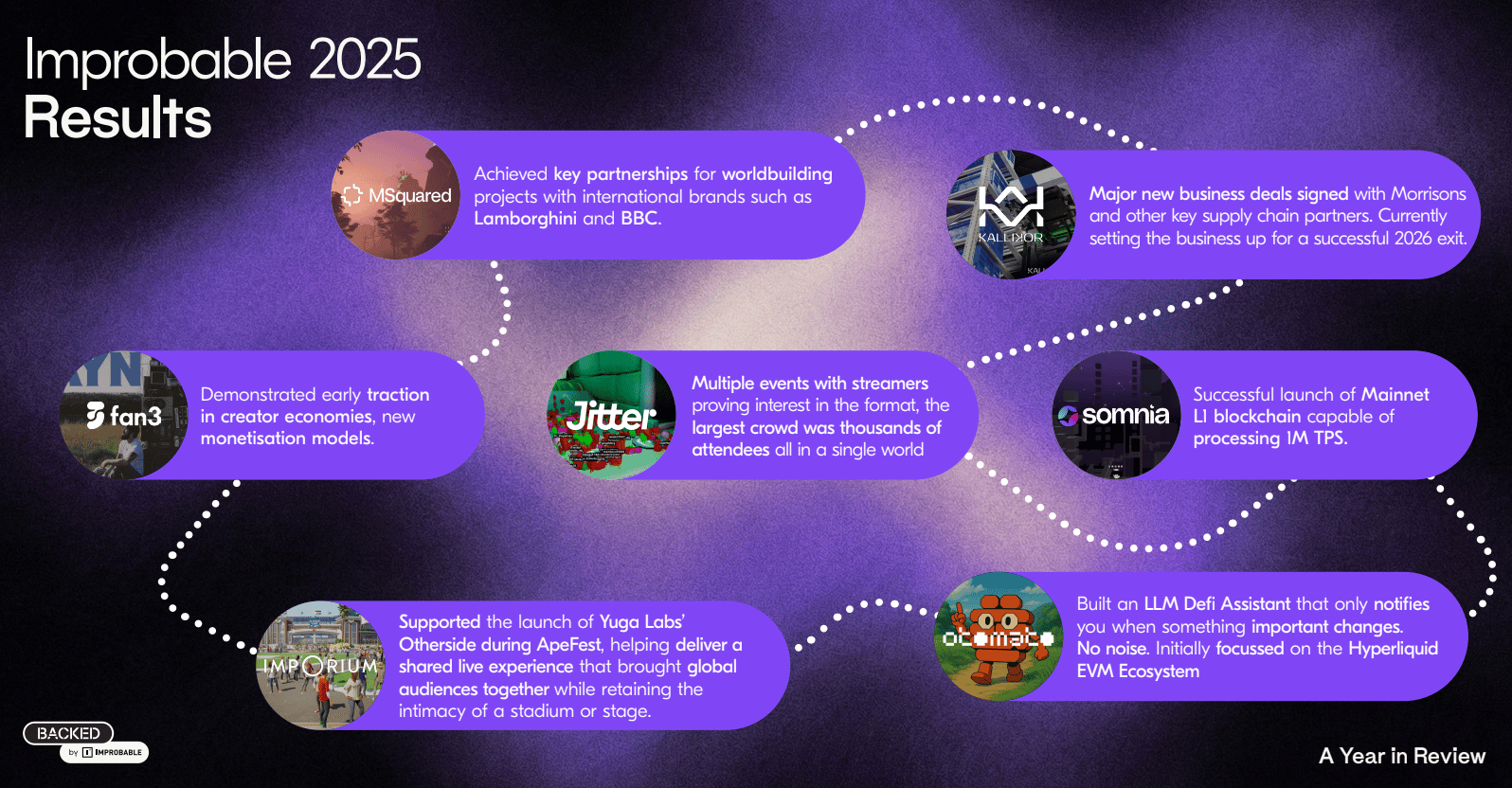
MSquared’s WebWorlds product powered virtual experiences for global brands such as Lamborghini and the BBC, and the Morpheus Unreal platform provided the underlying technology for a successful Otherside launch.
Somnia moved to Mainnet for its high performance L1 blockchain, achieving one million TPS and onboarding nearly sixty projects into the ecosystem. Alongside technical progress, the organisation has continued to invest in its leadership and all core functions, laying the groundwork for its 2026 programmes.
Kallikor continued to deliver strongly, advancing product development and securing new enterprise contracts with Morrisons and other major supply-chain operators.
Chamber completed a substantial technical rework, transitioning the product from Unreal to Web. Following its first in-person marketing events this year, the company is focused on early go to market execution.
Jitter demonstrated a commercially viable model through multiple large-scale events, the largest of which brought in 2,400 concurrent users all in a single shared world. The events helped demonstrate demand for Jitter’s unique mix of an immersive, shared experience combined with a streamer presenter.
Otomato joined the Improbable ecosystem in Q3, aligning quickly around a strategy focused on building for a hyper-liquid EVM chain and refining its product to meet that vision.
Imporium continued scaling interactive, live entertainment that turns fleeting moments into lasting communities. In partnership with Yuga Labs, the studio helped launch Otherside at ApeFest - building a shared live experience designed for global participation.
fan3 continued to build early traction in the creator economy, exploring new monetisation models that reflect evolving behaviours in digital culture.
Taken together, these ventures show that digital innovation in 2025 was not just about faster technology, it was about designing systems that engage people, communities, and markets at scale.

Building something ambitious?
We work with founders solving complex problems in AI transformation, the metaverse, and Web3 – the kind that don’t get built alone.
Key moments that mattered in 2025 |
What we saw across our ventures this year highlights a market converging around systems, platforms, and human behaviour, the very foundations of richer, more interconnected digital worlds. Builders are no longer just creating products; they are designing systems that scale, empower users, and enable seamless interaction between creation, identity, and economic activity.
The moments that stood out in 2025, both within our ecosystem and across the market, signal where builders are already heading:
Founders are no longer building products in isolation. Today’s founders design interconnected platforms, where multiple products and features interact. Shared infrastructure is essential to keep these systems reliable, scalable, and maintainable.
AI pushed capability beyond the limits of current game engines, exposing brittle foundations and making high-performance shared infrastructure essential for turning rapid creation into scalable, persistent experiences.
AI and Web3 are converging to power a new class of digital experiences. Generative models can now create on-chain assets, environments, and logic, enabling dynamic, persistent worlds and programmable economies at scale. Early experiments show creators using AI to automate complexity and unlock interoperability previously out of reach.
At the same time, capital pulled back from metaverse and 3D entertainment. Funding slowed before user demand did. While immersive experiences proved harder to monetise in the short term, appetite for richer, more participatory digital environments did not disappear. What paused was speculative capital, not the direction of travel.
DeFi regained momentum — quietly, and for the right reasons. With speculation drained away, DeFi returned to its core function as programmable, composable financial infrastructure. Stablecoins stabilised, cross-chain protocols matured, and on-chain components began slipping naturally into consumer applications.
The same Web3 plus AI convergence is now reshaping DeFi and emerging information finance. Financial systems are moving from static rules to adaptive intelligence. AI agents can manage liquidity, assess risk, optimise strategies, and interpret market signals directly on chain. In InfoFi, AI is enabling prediction markets, programmable information systems, and new mechanisms for pricing truth, attention, and coordination. These systems are evolving from passive financial primitives into intelligent networks that learn and respond in real time.
Gen Z began breaking up with the feed, with new research from MSquared showing that 92% of young people want immersive and interactive online experiences over traditional scrolling formats. Despite spending over six hours of personal time online daily, 87% say feeds cannot deliver the connection or creativity they want. Half have already explored virtual worlds, 63% see 3D spaces as the next evolution of online engagement and 70% want brands to extend their websites into these environments.
That’s it for this year.

From technical benchmarks to immersive fan experiences, the ventures in the Improbable ecosystem exemplify a new approach to building: one that combines technology, human behaviour, and community. As 2026 approaches, immersive and AI-driven experiences will scale rapidly, virtual economies will mature, and shared infrastructure will continue to underpin the next wave of innovation.
Thank you for following our journey this year — we’re excited to share the next breakthroughs with you.
Have feedback, suggestions or topics you'd like us to dive into? Email us at: [email protected].